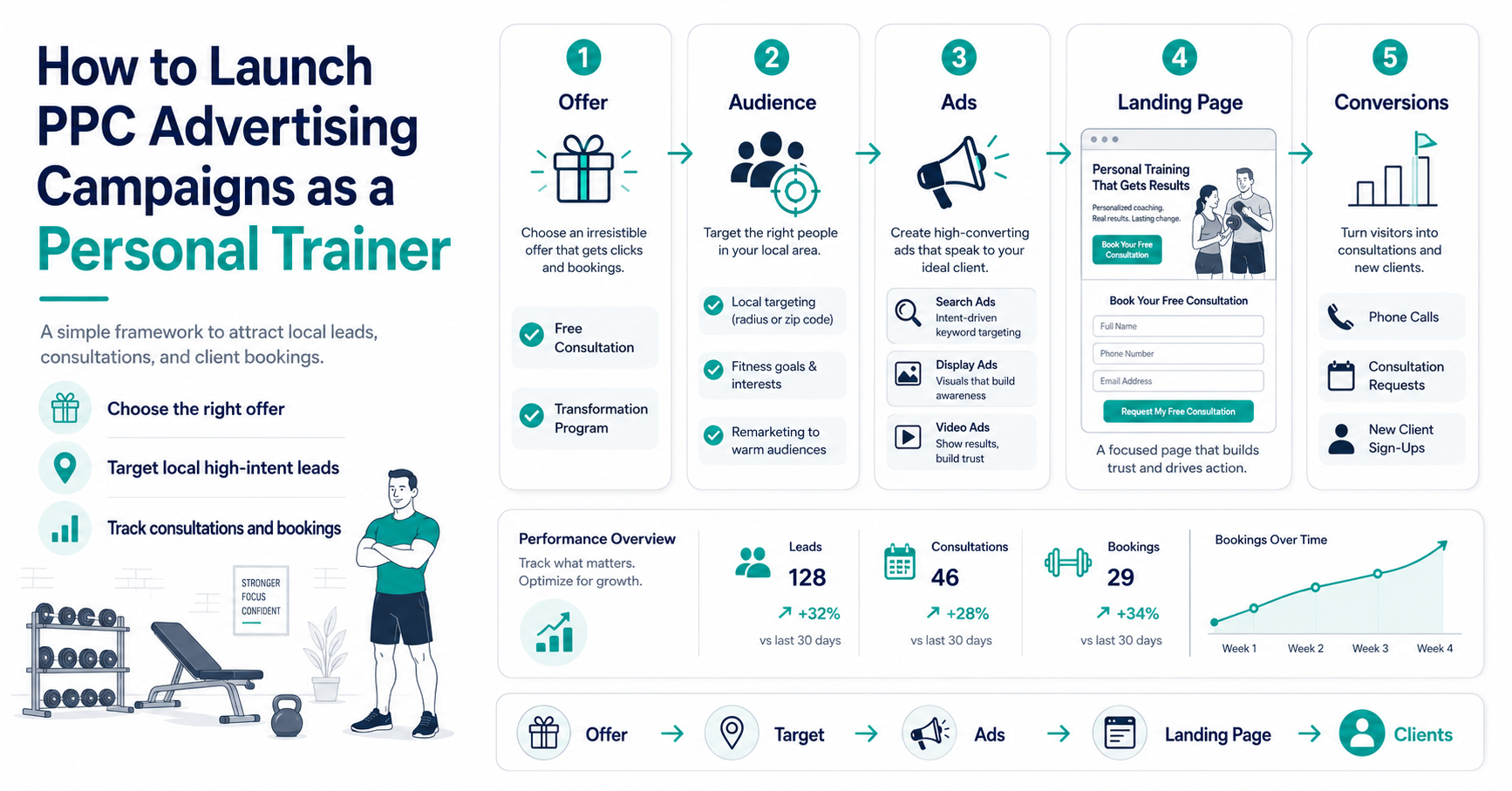
PPC advertising can put a personal trainer in front of people who are actively searching for help, but a campaign does not become profitable simply because the keywords are relevant. The offer, client value, service area, landing page, response process, and conversion tracking all have to work together.
The most reliable launch process borrows from the same measurement discipline used in paid search strategy for health and wellness services: advertise one valuable service, make the next step easy, and follow every lead through to a signed client.
This guide explains how a personal trainer can launch a focused PPC campaign without spreading a small budget across too many services or judging performance before the data becomes meaningful.
Content
What This Post Covers
Calculating an acceptable client acquisition cost
Choosing one offer for the first campaign
Defining geography, availability, and scheduling
Building high-intent keyword and negative keyword lists
Writing ads that communicate a real difference
Creating a consultation-focused landing page
Tracking leads, consultations, and signed clients
1. Calculate the Economics Before Opening Google Ads
Start with average client value. Multiply the typical monthly payment by the average number of months a client stays, then adjust for refunds, discounts, and delivery costs when those are meaningful.
Next, determine the highest acquisition cost the business can accept while maintaining a healthy margin. A recurring coaching package can usually support more advertising expense than a single session. This is why low-value one-time offers often struggle in paid search even when the campaign generates leads.
Question to Answer: What is one new client worth over the full relationship, not just the first session?
2. Choose One Service and One Audience
A small launch budget should not promote in-home training, online coaching, weight loss, senior fitness, sports performance, and post-rehabilitation services at the same time. Each service attracts different searches and requires a different message.
Choose the offer with the strongest combination of demand, client value, available capacity, and trainer expertise. Examples include a twelve-week strength program, monthly in-home training, small-group coaching, senior mobility training, or a post-rehabilitation fitness package.
Question to Answer: Which one service has the best economics and the clearest ideal client?
3. Set the Service Area and Schedule
Local targeting should reflect how the service is delivered. A trainer working from one studio may target a tight radius, while an in-home trainer may use selected towns or ZIP codes that fit travel time and pricing.
Do not target a large region simply to generate more impressions. Traffic from areas the trainer cannot serve efficiently creates wasted clicks and difficult scheduling. Exclude locations that are outside the realistic service area.
Question to Answer: Which locations and appointment times can you serve consistently and profitably?
4. Build a Focused Keyword List
Begin with keywords that indicate someone is looking to hire a trainer. Examples may include “personal trainer near me,” “in-home personal trainer,” “personal trainer for seniors,” “private fitness coach,” or a specialty term connected to the chosen offer.
Start with approximately 15 to 20 phrase- and exact-match keywords. A focused list makes it easier to understand which searches are producing consultations. Broad match can be tested later after the account has reliable conversion data and a mature negative keyword list.
Separate general and specialty intent when the budget allows. A search for a general personal trainer may require a different ad and landing page than a search for post-rehabilitation or prenatal training.
Question to Answer: Do the starting keywords describe people looking to hire a trainer now?
5. Add Negative Keywords Before Launch
Personal training campaigns attract job seekers, certification research, free workout searches, equipment shoppers, and people looking for apps or templates. Those clicks can consume a small budget quickly.
Create negatives for terms related to jobs, salary, certification, courses, exams, free plans, PDFs, YouTube, equipment, apps, and do-it-yourself workouts. Add location negatives when searches repeatedly come from areas outside the service zone.
Question to Answer: Which non-client searches are most likely to trigger your ads?
6. Write Ads Around the Offer, Not the Credential
Certifications support trust, but they are rarely the strongest headline. Many trainers are certified. The ad should first communicate who the service is for, how training is delivered, and what the prospect should do next.
Useful details may include in-home availability, small-group format, a defined program length, flexible scheduling, a free consultation, or experience with a specific population. Use claims the trainer can support and avoid promising guaranteed physical outcomes.
Question to Answer: Does the ad explain a meaningful reason to choose you instead of another trainer?
7. Create a Landing Page for the Consultation
The landing page should continue the exact conversation started by the keyword and ad. State the audience, service format, location, first step, and expected process near the top of the page.
Include real photos, relevant testimonials, trainer qualifications, a starting price or pricing explanation, and answers to common objections. Keep the form short and offer online scheduling when possible.
Test the page on a phone. A visitor should be able to understand the offer and schedule or request a consultation without navigating through the rest of the website.
Question to Answer: Can a mobile visitor request a consultation in less than one minute?
8. Configure Conversion Tracking Before Spending
Track phone calls, form submissions, and online bookings as separate actions. Use a reasonable call-duration threshold so wrong numbers and immediate hang-ups do not count as qualified conversions.
The tracking process should continue outside Google Ads. Record whether each lead scheduled, attended, and signed. A spreadsheet or basic customer relationship management system is enough at the beginning if it is updated consistently.
When possible, import qualified outcomes back into the advertising platform. Optimizing toward signed clients or attended consultations is more useful than optimizing toward every form submission.
Question to Answer: Can you connect each signed client back to the campaign and keyword that generated the lead?
9. Launch With a Budget That Can Produce Data
Set a monthly budget based on expected click costs, landing-page conversion rate, consultation rate, and close rate. A budget that buys only a small number of clicks may not produce enough consultations to evaluate the offer or bidding strategy.
When funds are limited, concentrate them. One campaign receiving consistent traffic is more useful than five campaigns that each generate a few clicks. Protect the highest-value service first and expand only after the initial campaign produces repeatable results.
Question to Answer: Can the budget generate enough qualified visits and consultations to evaluate performance?
10. Manage the First 90 Days in the Right Order
During the first month, focus on search terms, geographic quality, tracking accuracy, landing-page behavior, and lead response. Do not make decisions based only on click-through rate or one early client.
In the second month, compare keywords and ads by qualified consultation volume. Improve the page when clicks are strong but leads are weak. Improve the follow-up process when leads are strong but consultations are not scheduled.
By the third month, evaluate cost per signed client and estimated client value. Increase the budget only when the offer, conversion process, and retention economics support it.
Question to Answer: At which stage are prospects dropping out: click, lead, consultation, or signed client?
In Summary
A personal trainer should launch PPC with one profitable service, one defined audience, and one measurable conversion path. Broad campaigns are harder to control and usually waste limited budgets on searches that do not match the strongest offer.
Set the economics first, target a realistic service area, use high-intent keywords, remove irrelevant traffic, and send every click to a focused consultation page. Then respond quickly and track the lead all the way to a signed client.
The campaign should be judged by client acquisition cost and client value. When those numbers work, PPC becomes a scalable growth channel instead of an unpredictable expense.
Anna Leake is a health blogger that focuses on topics related to nutrition, fitness, and mental health. She was born in New York City but at age 6 moved to the Midwest where she spent her childhood exploring nature with friends and family. Anna graduated from University of Michigan-Ann Arbor with degrees in psychology & human development.